How I Finally Ended My Chronic Back Pain
My father's back pain was one of the first things I ever understood about the world.
Not in any conscious way, but just by watching him position his spine in strange, custom-crafted foam blocks while he stretched to treat an "imbalance."
The special lumbar supports for chairs and car seats.
The ointments, the gadgets, the long rotating cast of chiropractors, surgeons, massage therapists, osteopaths, energy workers, and acupuncturists.
Not being able to sit through movies because of the unsupportive seats and making sure whatever vehicle he rode in had the proper suspension.
By the time I was old enough to notice, chronic pain was simply part of the architecture of our family.
It started in 1970. My father was 28 years old and living in San Francisco. My mother was pregnant with me. Without warning, he had a lower back spasm so severe he passed out from the pain.
The doctors eventually found a disc protrusion on an MRI. He had surgery in 1987.
After a very long recovery, the pain got worse.
He managed the pain with medication for the rest of his life, and when esophageal cancer came seven years ago, I could not help wondering what four decades of swallowing pain management meds had cost him.
I grew up convinced that the human spine was poorly designed and inherently fragile. That conviction followed me into adulthood, into a career as a personal trainer, into every workout I ever carefully, cautiously, meticulously approached with a lumbar support belt cinched tight.
It did not help.
I was 24 years old and doing barbell rows on a cold San Francisco morning. On the first set, I felt a pop in my lower back and went straight to the floor.
I spent most of the next two months lying down in agonizing pain.
I spent thousands on chiropractors, massage therapists, acupressurists, and acupuncturists. I even drove hours to see renowned energy healers.
None of it moved the needle. What did not make sense was this: sometimes the pain would vanish completely for a day, then return without cause.
I finally succumbed to getting an MRI, which confirmed my worst nightmare: a herniation at L4-L5. Three other discs showed severe degeneration.
Even more discouraging, I kept getting strange symptoms in places that had no anatomical connection to the disc they had found on the scan.
The orthopedic surgeon recommended immediate surgery and told me I should stop lifting weights along with any other sports — permanently.
Every specialist had the same answer: the spine is complex, we are still learning. That was not a satisfying answer when someone was suggesting they cut it open.
The Radio Interview that Changed my Life
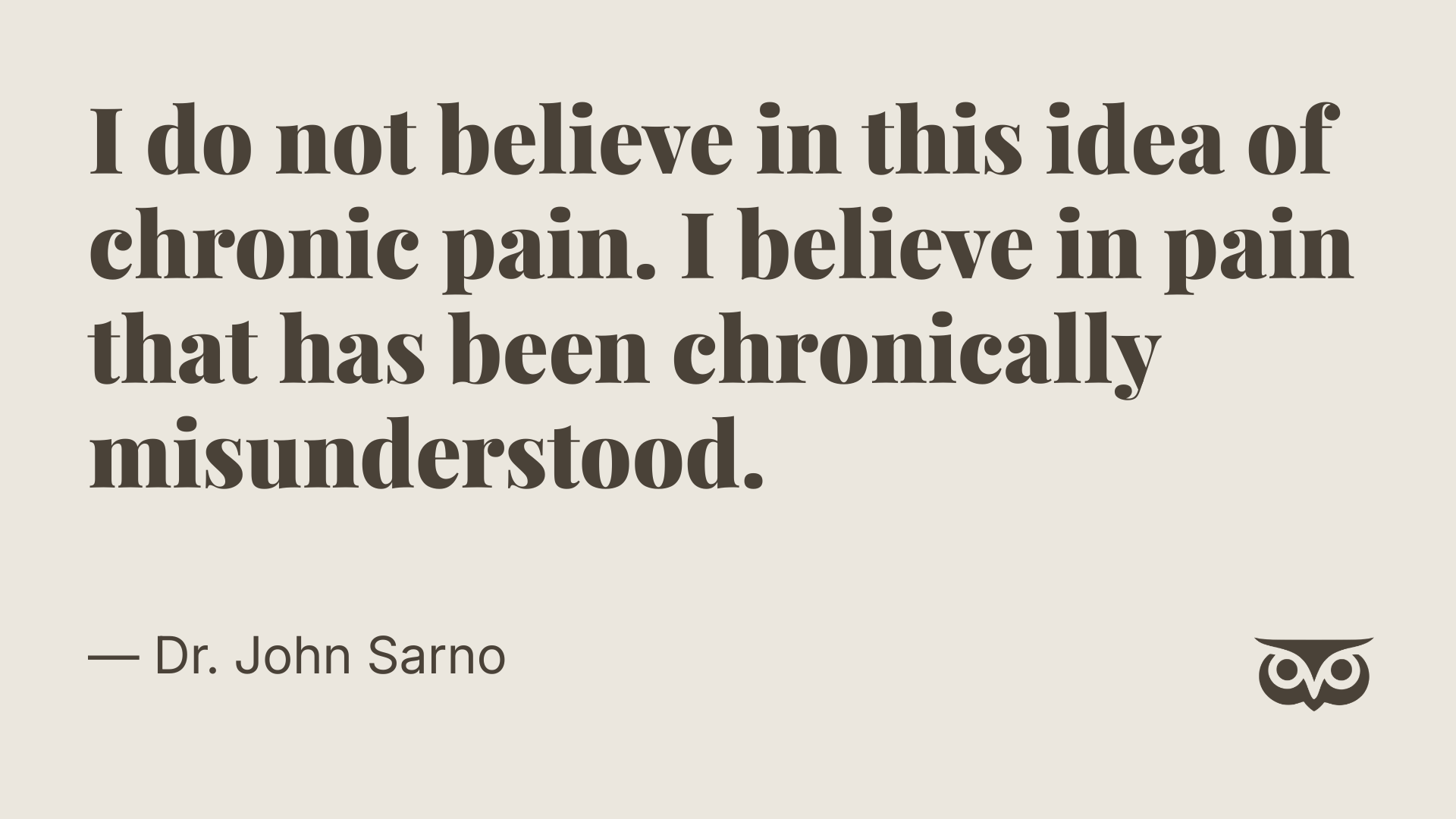
Another couple years into it, I had decided that being a trainer was not a tenable career with my broken back. One morning on my commute into my office job, lumbar support wedge in the seat, I caught a segment on The Howard Stern Show. A physician named Dr. John Sarno was the guest. Howard had talked about Sarno on the show many times before.
Caller after caller described how Sarno had ended their chronic back pain. Howard himself credited Sarno with curing his.
I could not quite grasp how this was possible, but the next day I bought his book, Healing Back Pain.
In about two weeks, I was roughly 80% better. A few months later, I was completely pain-free.
I know that's hard to believe.
No additional physical treatments.
No ointments, no gadgets, no surgery.
No pain.
What Sarno described was a phenomenon he called Tension Myoneural Syndrome. The short version: the brain, under pressure from accumulated emotional stress it cannot consciously process, creates a mild restriction of blood flow to muscles or nerves.
The result is real, physical pain. Not imagined. Not fabricated. Real. But generated by the nervous system as a distraction from something the unconscious finds even more threatening: the emotional weight underneath.
The cure, in many cases, is simply understanding this. The knowledge disrupts the strategy. When you stop believing the pain signals a structural injury, the brain's distraction tactic loses its grip.
Sarno called this the knowledge cure. Some patients recovered just from reading the book. Others needed more.
But the direction was always the same: stop reinforcing the idea that something is physically broken, and start looking at what is actually going on in the brain.
The questions Sarno asked that I could not stop thinking about:
Why does the pain sometimes disappear for no reason?
Why do people with identical MRI findings have wildly different symptoms, or no symptoms at all?
Why does most chronic back pain only appear in industrialized nations, and why has it exploded in the last fifty years?
If the spine were truly that fragile, how did our species survive millions of years of physical hardship?
I had no good answers. Neither did anyone I had paid to help me.
Learning From the Relapse
Years passed. The pain stayed mostly quiet. Then, on a winter break trip, it came back hard.
I was at the gym a few hours before a long flight. We were traveling with our baby and our older daughter. My wife had a broken ankle. I had not finished the work I intended to before leaving, and I was already bracing for a complicated visit to family.
As I started my first set of deadlifts, I felt a sharp spasm in my lower back. By the time we landed at my in-laws, it hurt to breathe. I spent three days on muscle relaxers, lying in the snow trying to get relief, completely convinced I had injured myself.
It was not until the pain started migrating into places that made no anatomical sense that I remembered the lesson of neuroplastic pain. I downloaded Sarno's follow-up book, The Mindbody Prescription, that night.
By morning, the pain was gone.
I cannot fully explain what it is like to go from that level of pain to nothing. It is not subtle. It is more like someone flipping a switch.
What happened next was the part I did not see coming.
A few weeks after that trip, I started getting spasms again after a tough workout. This time, a licensed therapist who completed most of her clinician hours treating neuroplastic pain walked me through a series of questions.
At some point in that conversation I heard myself say, out loud in anger, that I was furious that I understood exactly what was causing this and it kept happening anyway. That I knew there was nothing physically wrong with me and I was still falling for it.
The moment I said it, I felt warmth flood into the area that had been spasming. The pain released. I actually felt the shift, as if someone opened a valve.
That experience changed how I understood the role of therapeutic conversation in treating this kind of pain. It is one thing to read your way to relief. It is another to have someone guide you through the process.
The Circle That Took Twenty-Five Years to Close
That therapist who led me out of pain that last time around was my wife and now my business partner. Danielle is a licensed psychotherapist with deep expertise in pain psychology, having completed most of her clinician training hours under Alan Gordon at The Pain Psychology Center in Los Angeles.
Chronic pain is one of our core pillars at The Wise Mind Group. Not because it is a clinical specialty we selected from a list, but because we have lived inside it and found our way out.
This spring, I also completed the Pain Reprocessing Therapy Training through Alan Gordon's program, the very work that changed my life forever. The training covered the neuroscience of chronic pain, somatic tracking, the pain-fear cycle, and evidence-based techniques for helping people recognize when pain is neuroplastic rather than structural.
Pain Reprocessing Therapy is not a fringe idea. It is backed by a randomized controlled trial published in JAMA Psychiatry showing that 66% of participants with chronic back pain were pain-free or nearly pain-free after treatment, compared to 10% in the control group.
The mechanisms Sarno described decades ago are now being mapped by neuroscience.
The brain's role in generating and maintaining chronic pain is no longer a hypothesis. It is a finding.
If you have been in pain for weeks, months, or years, if you have tried the treatments and gotten the imaging and heard the explanations and still do not have relief, I am not telling you the answer is simple.
But I am telling you there is a question worth asking that most people never get asked:
What if the pain is real, and the source is not where anyone has been looking?
That question changed my life. My father never got to ask it.
If you want to explore whether this framework applies to what you are experiencing, we offer a free consultation at The Wise Mind Group. You can book directly here. We work with people in Utah and California for clinical therapy, and we offer behavioral coaching beyond those states.
What is neuroplastic pain?
How is this different from pain that has a physical cause?
Can an MRI or X-ray tell me if my pain is neuroplastic?
What is Pain Reprocessing Therapy and how does it work?
Does this mean my pain is all in my head?
Who is a good candidate for this kind of work?
Beyond the insight.
Knowledge is the first step; integration is the work. If you're ready to move these concepts into your actual life, let's talk about a strategic path forward.
Book a Consultation