

The Emotions You Stopped Letting In
The Quiet Erosion of Positive Feeling
You built a life most people would envy. So why would it be difficult to feel gratitude or joy? You’d like to feel those emotions more and maybe even feel like you should, but somehow you can’t seem to readily access them.
Gratitude arrives and something tightens.
A good moment surfaces and you're already calculating when it ends.
Someone tells you they love you and you smile, then quietly wonder what they want.
This is different than pessimism. It is not ingratitude. It’s actually a phenomenon so common it even has a name: Positive Emotion Atrophy and it’s something I see in so many of my clients, whether they’re coming in to heal from chronic pain, burnout, or treatment-resistant depression or anxiety.
Positive Emotion Atrophy describes what happens when high-functioning people spend so many years in threat-management mode that positive emotions, like joy, awe, love, and connection, become genuinely unfamiliar, and the nervous system begins treating these emotions we would theoretically wish to feel more of like signals to be suspicious of.
Here is why this happens: the brain is a prediction machine. Whatever it practices, it gets better at. You may have even heard the old adage: "Neurons that fire together, wire together."
In other words, the frequency of your thoughts and feelings can actually physically change the neural pathways in your brain.
If you have spent decades optimizing for risk, scanning for problems, and holding yourself together through discipline alone, those neural pathways have been shaped accordingly. Your brain got very good at the job you gave it.
But that comes with a hidden cost: the emotions outside that register — the warm, open, expansive ones — start to feel foreign and unfamiliar. And what feels unfamiliar to our nervous systems can feel threatening, even when it’s something positive.
Research on overcontrol, the clinical term for this pattern, describes it plainly: high inhibition of emotion combined with a strong internal drive for self-regulation produces people who appear composed from the outside while quietly losing access to the softer frequencies of their own experience.
The five traits in this evidence-based literature include inhibited emotional expression, perfectionism, cognitive rigidity, an aloof style of relating, and high social comparison.
Notice that none of these are flaws; they are adaptations. They worked.
Yet now they might be costing you something you may not even been able to articulate.
It is essential to know that positive emotions are not a luxury. They are essential in protecting against burnout, fostering resilience, and in connecting with those we love.
Barbara Fredrickson's broaden-and-build research at the University of Michigan found that emotions like joy, curiosity, love, and awe do something negative emotions cannot: they widen the aperture of thinking, expand the range of possible responses, and build the psychological resources that make resilience possible over time.
When those emotions shrink, so does your capacity to recover, connect, and adapt. Those brakes do not just slow you down, they change what roads you can take.
Positive Emotion Atrophy does not announce itself. Instead, it announces its absence.
A promotion arrives and you feel relief, not joy.
A vacation finally happens and you spend it waiting to feel something.
A friend reaches out and the connection feels thin, effortful, slightly off.
These are signs that a system has been running on one setting for too long.
Relearning the Register
The practice this week is not about forcing gratitude or hunting for silver linings. That would be like asking a muscle to perform a movement it no longer knows.
Instead, the goal is simple and deliberate: lower the threshold for noticing positive experience, without requiring yourself to feel it fully right away.
Let me teach you my very favorite practice for this.
Right now as you read this, ask yourself the question, “Is there anything in this moment to feel grateful for?” The key here is letting go of the shoulds. Yes, of course shelter and clean water are things many in the world lack, but trying to force yourself to feel gratitude to for those things will likely only make you feel worse.
Instead, this practice of asking ourselves the question helps widen the aperture of a nervous system honed to notice threat so that it can get better over time at taking in the fullness of each moment. Small sensory pleasures are often most accessible.
The warmth in your hand from a hot cup of coffee.
The smell of fresh rain or budding flowers.
A stranger holding the door open.
Sunlight streaming through a window.
A smile from someone you love.
Then pause for ten seconds. Only ten. Do not try to deepen the feeling or analyze it.
Simply hold it in your attention long enough for your nervous system to register that it happened. You are not manufacturing joy or trying to overlook what’s difficult. You are training your brain and nervous system to get better at noticing positive stimuli, which we have a tendency to brush right by.
You are noticing that the signal is present, even if it is faint.
The research on emotional recovery suggests that Positive Emotion Atrophy responds to attention the same way a muscle responds to use.
Think of these little moments of noticing like a single bicep curl. One doesn’t have any noticeable results but over time, repetition creates strength.
You are learning the terrain of your own positive experience, not demanding that it become a mountain before you acknowledge it exists.
Over time, your emotional register slowly widens. Not because you forced it, but because you stopped actively ignoring the signals that did not fit the threat-management protocol.
These are the practical, accessible things we can incorporate into our daily lives to help heal the maladaptive property of an overcontrolled mind. These aren’t dramatic reversals, but rather quiet, deliberate reopenings, one ten-second pause at a time.
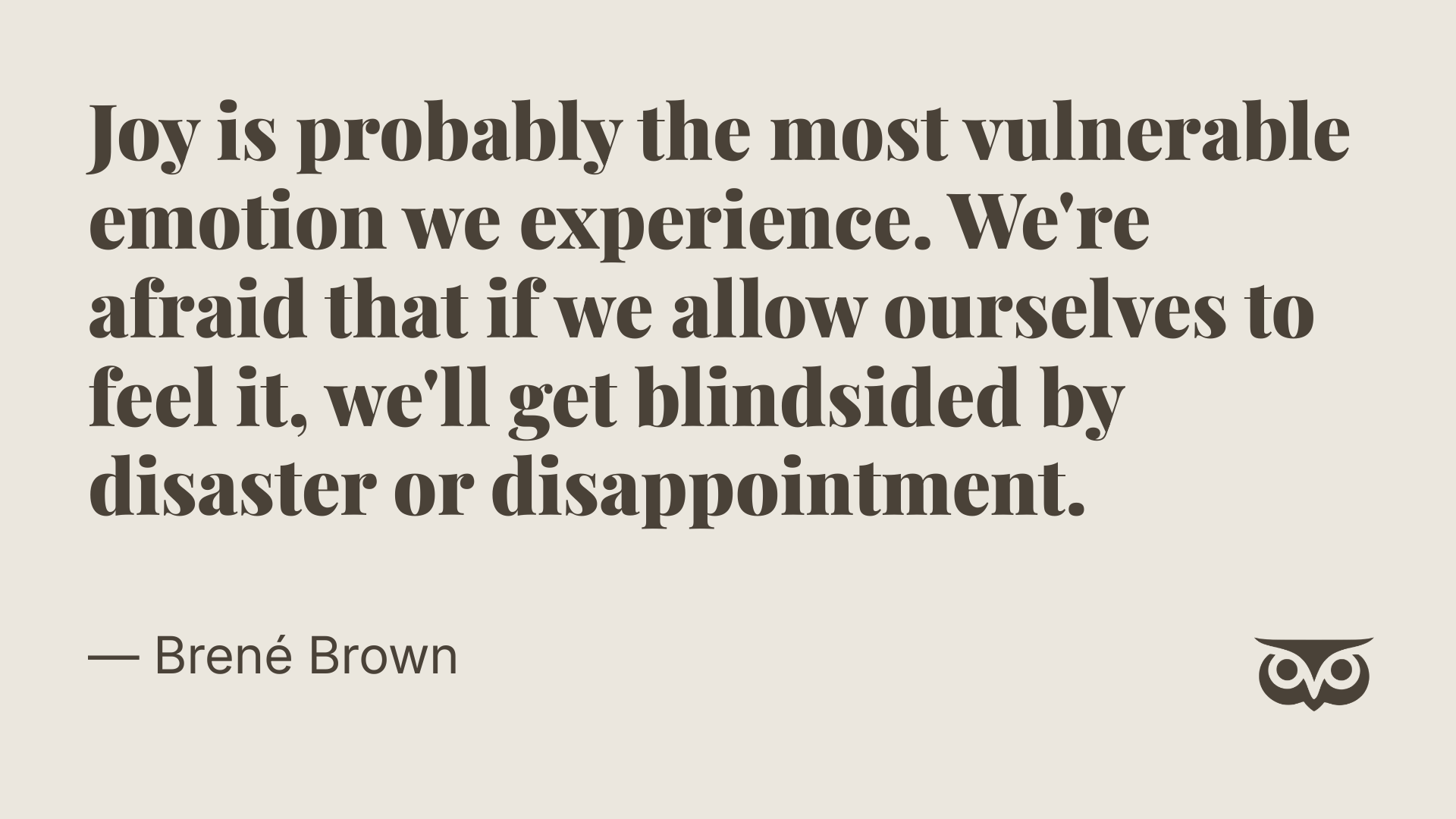
Joy is not looking for the perfect conditions; instead it is cultivating a nervous system able to notice it arrived.
Why don't I feel happy even when things are going well?
What is Positive Emotion Atrophy?
Is it normal to feel relief instead of joy when something good happens?
Why do high achievers struggle to enjoy positive experiences?
How do I rebuild my capacity for joy and positive emotion?
Is this related to depression or burnout?
Beyond the insight.
Knowledge is the first step; integration is the work. If you're ready to move these concepts into your actual life, let's talk about a strategic path forward.
Book a Consultation