

The Voice in Your Head Has a Tone — and Your Amygdala Is Listening
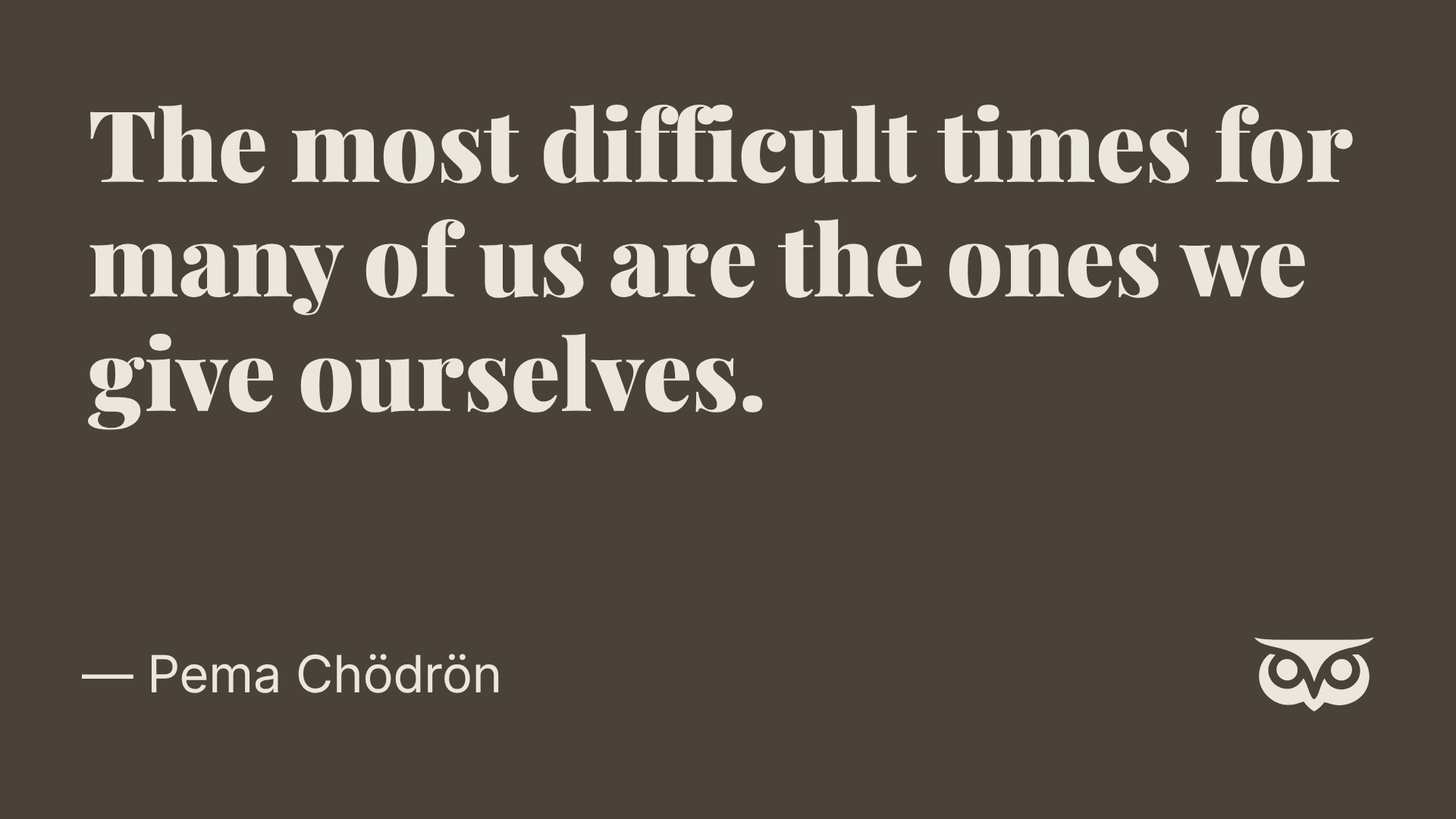
Recently a client told me about a test she brought home as a child, a 104%, because even though she had missed a question on the test, she'd nailed two extra credit ones. She excitedly showed her dad the test and her father's first words weren't about the 104. They were: "Why did you miss that question?" She assured me her father was not trying to be harsh. Her father thought he was being engaged: curious, invested, helping her sharpen. But her nervous system didn't file the moment under "well-intentioned." It filed it under threat and it's been replaying that one missed question loop, in one form or another, ever since.
What the Inner Critic Thinks It's Doing
This is the pattern I see constantly in overcontrolled (OC) clients, and it usually starts from something like that father's question. But somewhere between childhood and the therapy room, the voice doesn't stay at "why did you miss that question?" It sharpens. For most of my clients, the internalized version isn't measured or well-intentioned at all: it's outright mean. Find the error. Replay it. Attack. The origin may have been a parent, teacher, or coach who thought they were helping; the voice that took up residence never stays that gentle.
My clients become convinced that voice is both helpful and always telling the truth. Until I started my own healing I was completely identified with that voice and believed it was me. Of course you should study the mistake. Of course a 104% doesn't excuse a wrong answer. Of course you are deeply flawed and should constantly be working to correct and improve and how would you do without an inner monologue constantly running to remind you? Over time, the cruelty isn't incidental to the correction: the voice has determined that harshness is what makes the lesson stick. It flags the error, calls you names for making it, and replays the mistake over and over in an attempt to force you to learn from it.
I reassure my clients that the intention of the critical voice is to try to keep them safe in the only way it knows, which is by doing whatever it can to focus on their mistakes and failings. When the only tool you have is a hammer, everything starts to look like a nail. The inner critic functions just like that, working constantly and relentlessly to point out your mistakes and flaws in its best efforts to help. It's a young, scared part of us that, somewhere along the way, determined that the best way to keep us in connection with the people we love is to try to prevent us from ever making mistakes. The problem lies in what the brain actually does with that tone of voice, repeated over years.
The Brain Doesn't Grade on Intent
Brain imaging research on self-criticism shows that harshly evaluating yourself activates the exact same threat-processing circuitry, the amygdala and insula, that lights up in response to interpersonal rejection or an external criticism. Self-reassurance, by contrast, recruits circuitry associated with affiliation and soothing. The brain, in other words, does not reliably distinguish "the critic is me" from "the critic is a hostile other." Our brains have no sense at all that the call is coming from inside the house.
This is where repetition becomes the real problem. The content of a self-critical thought matters less than what happens when that thought runs on a loop.
Most threat responses habituate with repeated safe exposure. You walk into the same dark parking garage enough times without incident, and your nervous system eventually stops treating it as a threat. Self-critical rumination does the opposite. Each replay confirms the danger instead of disconfirming it. The amygdala does more than react to the harsh self-talk. Cycle after cycle, it learns that vigilance was actually the correct call. That's sensitization, the reverse of habituation. And it's the literal, mechanistic link between chronic self-criticism and the anxiety and avoidance that show up downstream: shutting down instead of starting, cycles of burnout, and procrastinating on the very tasks the inner critic is supposedly trying to improve.
What Happens When the Response Stays Neutral
The contrast matters because it points to something more useful than just "stop being harsh." When a mistake is met with neutral acknowledgment instead of self-attack, the threat response doesn't get triggered which means the brain's regulation circuits, centered in the prefrontal cortex, stay online rather than getting hijacked by the amygdala.
This is the part that tends to surprise people: staying regulated is actually the more effective option, and the kinder one too. A prefrontal cortex that's still online is what allows for perspective-taking and actual problem-solving: noticing what went wrong, considering what to do differently, holding the mistake in context alongside everything that went right. A prefrontal cortex that's been knocked offline by a threat response can't do that work nearly as well, because it's busy managing a nervous system that's just been told it's under attack. Harsh self-criticism feels worse, and it interferes with the very correction it's trying to produce.
Why This Hits OC People Harder
Overcontrolled (OC) temperament already runs high on threat-sensitivity and comparatively low on reward-sensitivity. That's the nervous system baseline before the inner critic ever opens its mouth. Layer years of "why did you miss that question" self-talk on top of a system already primed to treat vigilance as safety, and the harsh internal commentary lands as confirming data rather than as noise. This is precisely why our work at The Wise Mind Group targets tone of voice, including self-directed tone, as a direct intervention point rather than a soft skill. Warmth works as the mechanism that turns down the threat response, independent of whether the self-assessment itself was accurate.
The Same Circuitry Amplifies Physical Pain
This threat-sensitized amygdala extends well beyond emotional experience. It is central to the development and maintenance of neuroplastic pain. Pain, at its root, is the brain's alarm system: a signal generated when the brain concludes that a body region is in danger and needs protecting. The amygdala is part of the circuitry that makes that danger assessment, alongside regions like the anterior cingulate and insula.
A nervous system already primed toward threat by years of harsh self-talk is a nervous system more likely to interpret ordinary physical sensation as dangerous. Sensitization doesn't stay in its lane. The same amygdala that's learned "vigilance was correct" from a decade of self-critical replay is the amygdala evaluating whether that twinge in your neck is a threat worth escalating into pain. This is a core premise of Pain Reprocessing Therapy: pain intensity tracks perceived danger rather than tissue status, and a sensitized threat system will generate or amplify pain even when the body is structurally fine.
This is why the self-talk work sits at the center of healing for clients dealing with neuroplastic pain. An inner voice that keeps signaling "something is wrong with you" is, at a physiological level, keeping the exact system that generates pain on high alert. Softening that tone feels better emotionally, and it lowers the baseline threat signal the brain uses to decide how much pain to produce.
A Practice for Building New Pathways
If harsh self-talk is a rehearsed pathway, the way out is to rehearse a different one until it's equally available, rather than trying to argue yourself out of it in the moment. With clients, I use a single standing question, held gently rather than forced:
Is there a more accepting way I could talk to myself in this moment?
Acceptance is the key here, and it means finding the statement that's actually more accurate, not denying reality or inventing something that isn't true. Harsh self-talk is usually unkind and imprecise both. It flattens a situation into a referendum on our worth as a person.
A client of mine has been practicing this directly. Her inner critic loves to provide a running commentary on the state of her apartment: "You're a complete slob whose apartment is such a mess. Why can't you get your life together?" or "You're such a disaster with all your unfinished craft projects." Predictably, this leads to avoidance and shutdown: the mess doesn't get addressed because the commentary makes the whole situation feel too threatening to approach.
After practicing the reframe question, she came up with two replacement statements on her own:
"I went through a rough divorce that didn't allow me to sort through all our belongings."
"I have lots of different things because my brain likes variety and novelty."
Notice what these actually do. They don't minimize the mess or claim it doesn't matter. They name accurate causes instead: a divorce that interrupted a sorting process, a cognitive style that seeks novelty, both delivered in a voice that doesn't put her nervous system on alert. That's the whole reframe: self-acceptance and honesty aren't in tension. Harshness only feels more honest because it's the version we've rehearsed more.
If you want to try this yourself:
Catch the moment. Notice the tone of the internal commentary. The way the inner critic works reminds me of the old joke about an older fish swimming by two younger fish. The older fish asks, "How's the water?" After he's left, one of the younger fish looks at the other and asks, "What the hell is water?" The inner critic becomes a default way of relating to ourselves such that it happens outside our conscious awareness and the only way to begin to shift it is to start to notice.
Hold the question, don't force an answer. "Is there a more accepting way I could talk to myself in this moment?" If nothing comes to mind, no matter. Simply beginning to ask the question is enough to start generating new neural pathways that will strengthen over time.
Look for causes. A more accepting statement usually names a reason (a divorce, a busy season, a brain that likes novelty) instead of a trait (lazy, a mess, can't get it together).
Expect the new pathway to feel challenging at first. The harsh version is well-worn precisely because it's been rehearsed for years, often since childhood. A new pathway takes repetition too, but this repetition builds safety instead of confirming threat. I always tell clients that it took many years of repetition to develop a brain with their current pathways, so it will require patience and time to create new ones. But it is so worth it.
You already know how to talk to someone you love when they make a mistake. The work is just teaching that same voice to answer when it's your own name being called.
Why does self-criticism backfire?
What is the inner critic, psychologically speaking?
Why does self-criticism hit people with an overcontrolled temperament especially hard?
Can harsh self-talk make physical pain worse?
What is a more effective alternative to harsh self-criticism?
How long does it take to build a new pattern of self-talk?
Beyond the insight.
Knowledge is the first step; integration is the work. If you're ready to move these concepts into your actual life, let's talk about a strategic path forward.
Book a Consultation