The Comfort of Distraction
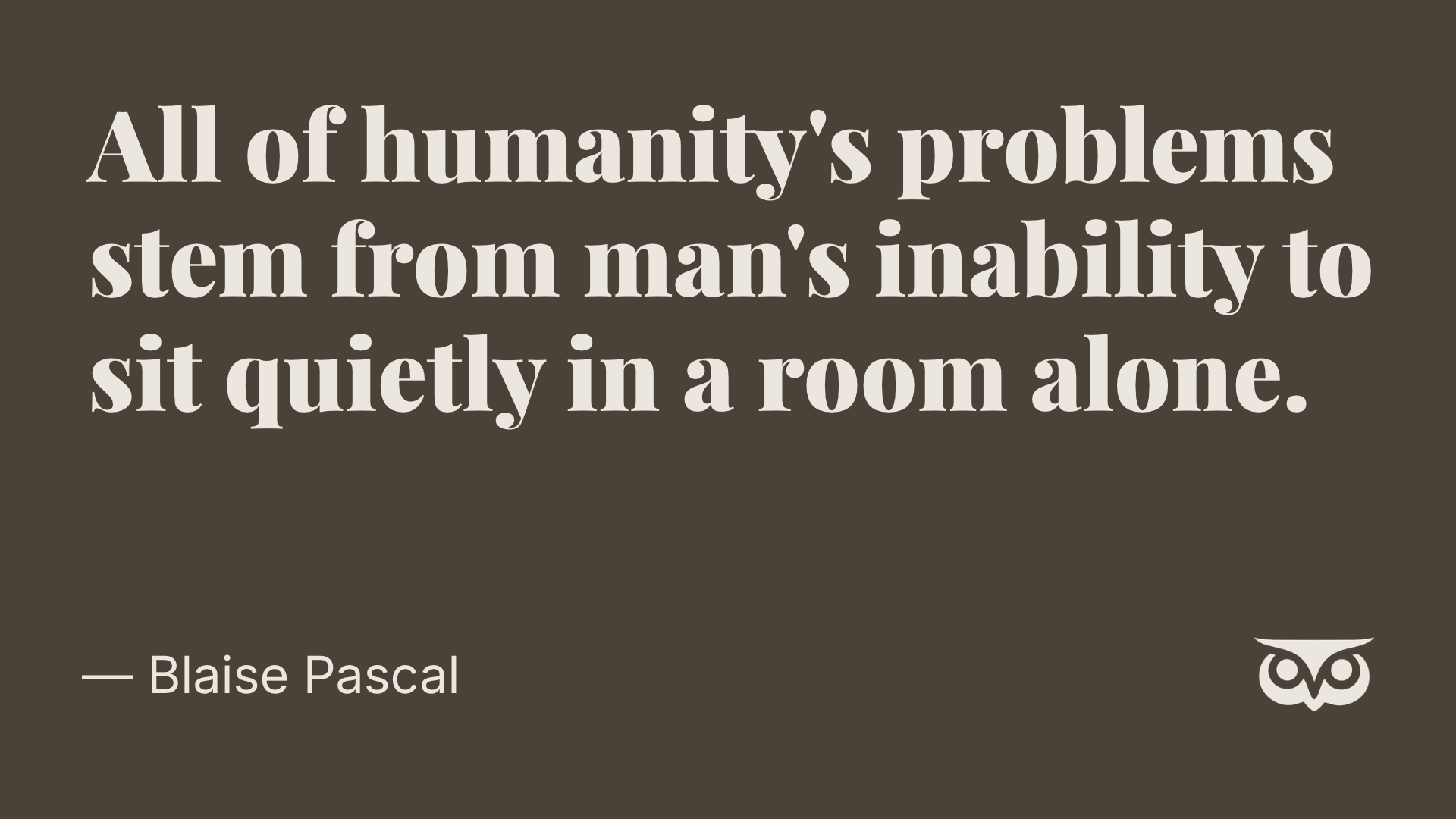
Some days, fifteen minutes alone with my thoughts can feel harder than almost anything on my calendar. As it turns out, I'm not alone. In 2014, a team of psychologists left people alone in a plain room for 15 minutes with nothing to do. No phones, nothing to write on, no distractions, no instructions, just whatever showed up inside. The only thing they were given was a button that delivered a mild electric shock, painful enough that every one of them had already said they would pay money to avoid it. Two out of three men pressed it at least once. So did one in four women. One man pressed it 190 times [1].
Busyness, phone checking, and nonstop problem-solving can become ways of escaping the feelings that show up when we finally stop. Because feelings live in the body, each escape teaches the nervous system that those sensations are dangerous, which keeps the threat response running and feeds anxiety and chronic pain.
Why Quiet Feels Like a Threat
Think about the last time you had four free minutes. A line at the pharmacy. A red light. The pause before a Zoom call starts. If you're like most people, your hand was already on your phone, and it likely wasn't a conscious decision. As a society, we have become addicted to distraction. And if you have overcontrol tendencies, the pull can be much more intense.
People who lean toward overcontrol are the ones we think of when it comes to perfectionism, conscientiousness, and a harsh inner critic. They also tend to treat a lapse in productivity as an existential threat. After years of living in that revved-up state, quiet starts to feel unfamiliar, and a brain built for survival registers anything unfamiliar as a possible threat.
So to avoid that threat, we reach for the next way to stay busy, often before we even realize we're doing it. The phone, the inbox, the next task, the mental rehearsal of tomorrow's tough conversation. Psychologists call this experiential avoidance, the habit of steering around uncomfortable feelings before they reach conscious awareness. Those feelings are more physical than we realize. Much of what we call an emotion starts as signals from inside the body: a racing heart, shallow breathing, a tight gut. Your brain reads those signals, factors in what's going on around you, and turns them into a feeling. Dread can show up as a knot in the stomach. Shame runs hot in the face.
Here's the strange part: the distraction doesn't get rid of those feelings; it only postpones them. Your brain learns mostly from what happens in the next few seconds, and in that brief window, the distraction works. Relief arrives right on time, so the habit gets stronger. Meanwhile, you never stay long enough to discover that the feeling would have crested and passed on its own. Your brain never gets the evidence that it was safe, so it keeps the feeling filed as dangerous, and the threat system stays on guard against something that was only ever a feeling. It's the same loop that drives any addiction.
When Productivity Becomes a Place to Hide
I'm intimately familiar with this trap. The thought of an unplanned day or a laptop with a low battery before a flight was worthy of a panic attack. In two decades of entrepreneurship, my answer to every problem was to do more. And the encouragement was fierce. Working insanely long hours, doing more as fast as you can, and rarely resting are badges of honor from startups to law firms. But if you are always trying to shove 10 lbs. of rocks in a 5 lb. bag without ever pausing to check the seams, that bag will eventually rip. Mine started to come apart after years of ignoring my feelings.
A fly on the wall would say productivity and avoidance look identical. Clearing the inbox, reworking the presentation, answering one more message before bed. Any of these can be real work. Any of them can also be an escape. If you lean toward overcontrol, this is where avoidance hides best, because it hides inside behavior everyone praises.
So how do you know which one you're doing in the moment? Here are three experiments to try this week.
The Stop Test: You usually can't feel what you're avoiding while you're avoiding it. It only becomes visible when you take the activity away, which is exactly what the shock study did. Run a smaller, less painful version yourself by putting down whatever you're doing for two minutes and just sitting. Watch the first 30 seconds. If not much happens and you could come back to the task later without a lot of inner turmoil, it probably wasn't avoidance. If something rushes in, like dread about tomorrow, tightness in your chest, or a strong pull to pick the task right back up, you've found the feeling that busyness was covering up.
Urgency Without a Deadline: If it feels like it has to happen right now, but nothing bad would happen if you waited ten minutes, or even ten days, the call is coming from inside the house. Researchers named this the Mere Urgency Effect. In a series of experiments, people willingly chose tasks with tight deadlines over ones that allowed more time and paid more. The ones most likely to do this thought of themselves as "busy people" [2]. Once I started looking for this in myself, I spotted it everywhere. I'll cook myself with long hours on a project that has no approaching deadline. I'll hurriedly scarf down my lunch to get back to a task that isn't urgent. I'll rush myself into a frenzy getting the kids out the door for school, when a few minutes late doesn't really matter. The irony is that avoidance tends to create the very feeling it's trying to escape. I rush so I won't feel behind, and the rushing is exactly what makes me feel behind. In the moment, ask one question: what actually happens if I slow down or this waits?
The Feeling You're Stepping Around: Ask yourself: is there something harder I'm not doing right now, and what is the feeling that comes with it? Some of the usual suspects include dread, exposure, or the fear of getting it wrong. Researchers who study procrastination have found that we usually put off tasks to escape the feelings they stir up [3]. The double bind is being caught between two uncomfortable feelings: the background nagging of putting off the task and the feeling you don't want to face by starting it. For those who chase productivity, an escape usually looks responsible, like reorganizing the garage while the tough conversation waits. But naming both feelings turns a vague pull into something you can actually work with.
Don't expect perfect answers when you ask these questions. But take solace in the fact that asking them in the first place is doing most of the work.
Why Symptoms Can Show Up When You Slow Down
During my recovery from neuroplastic back pain, four of my most painful relapses hit right before a vacation. I'd go to the gym to get in that one last workout before the trip and somehow injure myself. Then, once I'd been away a few days and actually unwound, the pain would vanish. Back then, I chalked the first part up to the worst luck ever. Now I see the pattern. The hardest part was the transition into rest.
Researchers have a name for the first half of that pattern: Leisure Sickness. People who reported getting sick on weekends and vacations had some traits in common. They tended to have heavy workloads, a strong sense of responsibility, and trouble relaxing [4]. In a small study of people with migraine, attacks were more likely the day after stress dropped [5]. When the busyness stops, the feelings it was covering have room to surface. A nervous system that has learned to treat those feelings as threats turns up its danger signals, and for people with neuroplastic symptoms, those signals often show up as pain, anxiety, or other issues.
The second half of the pattern is equally interesting. Plenty of people find their symptoms fade once they've settled into a vacation. Both are clues. Symptoms that shift with your stress level and state of mind are one of the strongest signs of a neuroplastic process. (Here's how to gather that evidence.)
That pattern also shows the way through. If symptoms flare on the way into rest and ease once you've settled, the discomfort of slowing down is temporary. It's a wave, and waves crest. Research on people who feel more anxious when they first try to relax suggests that those who stay with it until the anxiety settles get the most benefit.
Training the Untutored Mind
The researchers' conclusion is interesting: "The untutored mind does not like to be alone with itself" [1]. The key word is untutored. Being alone with yourself is a skill, and skills can be trained. That's the heart of mindfulness, which Jon Kabat-Zinn describes as paying attention on purpose, in the present moment, without judgment. Whatever is happening, inside you or around you, you notice it and let it be. If you struggle to keep a meditation practice going as much as I do, here are three small practices I've been experimenting with during the day.
One Mindful Breath: Chade-Meng Tan, an early Google engineer who went on to create the company's mindfulness program, suggests using every moment of waiting as a cue for one mindful breath. A red light, a line at the coffee shop, the progress bar when your software updates. Before you reach for your phone, take one slow breath with your full attention. Then check in with what you're feeling, and give it one word, like "restless," "sad," or "excited." That small step does more than it seems. In a UCLA brain-imaging study, simply putting a feeling into words quieted activity in the amygdala, the brain's threat detector [6]. You can still check your email or scroll Instagram afterward. The goal is to make the breath your go-to move before the phone. Whatever you do next, you'll do it with a little more awareness and a little less autopilot.
Urge Surfing: This one comes from addiction research. Psychologist Alan Marlatt developed it to help people ride out cravings, and we also teach it in our RO-DBT skills groups. In one study, smokers who got brief urge-surfing instructions smoked fewer cigarettes over the following week, even though their cravings were just as strong [7]. The urge still came. They just stopped obeying it on autopilot. To surf the reach for busyness, pause the moment you notice it and leave the phone where it is. Find the urge in your body: restlessness in your legs, pressure in your chest, a buzz in your hands. If it's your familiar symptom, the same steps apply. Watch it for about ten slow breaths, the way you'd watch a wave rise, peak, and fall. Let it be there, and tell yourself something true: "This is just my nervous system asking for stimulation. I'm safe right now." Then choose. Pick up the phone if you still want it, but do it intentionally.
Land the Transition: Busyness carries real momentum, and the hardest moments are the shifts: closing the laptop, walking in the door, Friday evening, the first morning of vacation. That's when the held-back feelings tend to surface, and when the urge to fill the space is strongest. So give those moments a small ritual. Before you move on to the next thing, sit for five minutes with no phone and no plan. Let whatever has been waiting come up, and meet it with the same steps: find it in your body, let it crest, and remind yourself you're safe. Each time, you're teaching your nervous system that the shift into rest is survivable. Start with one transition a day, like the moment you get home or sit down to dinner. If you have a vacation coming up, try it on the first morning before you open anything.
Last month marked 14 years of sobriety for me. In all that time, I've never felt anything close to the pull of addiction that I feel with busyness and productivity. I lean toward overcontrol, and our culture rewards the very habits that keep me out of touch with my feelings, wallpapering over any sadness, anger, or anything else I don't want to feel. And I can rationalize it far better than I ever could with drinking.
If you've ever felt like you're failing at sitting still, you're in good company. Most of us were never taught how, and it's never been easier to stay distracted. According to one recent survey, the average American checks their phone 186 times a day. So the next time you hit a red light, stand in line, or complete a task, try one of those exercises before checking your email or rushing off to the next thing. Whatever’s underneath the busyness has been waiting a long time. It might be worth meeting.
Stay Open,
Eli
Why do I feel anxious when I'm not busy?
What is experiential avoidance?
How can I tell if I'm being productive or avoiding something?
Why do I get sick or have pain flare-ups on weekends or vacations?
What is urge surfing?
How is overcontrol related to staying busy?
Beyond the insight.
Knowledge is the first step; integration is the work. If you're ready to move these concepts into your actual life, let's talk about a strategic path forward.
Book a ConsultationSources
Wilson TD, Reinhard DA, Westgate EC, Gilbert DT, Ellerbeck N, Hahn C, Brown CL, Shaked A. Just think: The challenges of the disengaged mind. Science. 2014;345(6192):75-77.
Zhu M, Yang Y, Hsee CK. The mere urgency effect. Journal of Consumer Research. 2018;45(3):673-690.
Sirois F, Pychyl T. Procrastination and the priority of short-term mood regulation: Consequences for future self. Social and Personality Psychology Compass. 2013;7(2):115-127.
Vingerhoets AJJM, van Huijgevoort M, van Heck GL. Leisure sickness: A pilot study on its prevalence, phenomenology, and background. Psychotherapy and Psychosomatics. 2002;71(6):311-317.
Lipton RB, Buse DC, Hall CB, Tennen H, DeFreitas TA, Borkowski TM, Grosberg BM, Haut SR. Reduction in perceived stress as a migraine trigger: Testing the "let-down headache" hypothesis. Neurology. 2014;82(16):1395-1401.
Lieberman MD, Eisenberger NI, Crockett MJ, Tom SM, Pfeifer JH, Way BM. Putting feelings into words: Affect labeling disrupts amygdala activity in response to affective stimuli. Psychological Science. 2007;18(5):421-428.
Bowen S, Marlatt A. Surfing the urge: Brief mindfulness-based intervention for college student smokers. Psychology of Addictive Behaviors. 2009;23(4):666-671.