

The Overcontrol Pattern Behind Chronic Pain
Have you ever wondered why you seem to be more prone to chronic pain than other people? Do you notice that you tend to suffer from injuries that linger inexplicably or become debilitating in unpredictable ways? Have you tried all of the conventional treatments? Trigger point injections, nerve blocks, physical therapy, steroid shots…but never had them result in any lasting relief?
Most people who live with chronic pain have the same question: “Why me?” Up until very recently, we have not really understood why this type of pain tends to affect certain types of people more profoundly than others. But emerging research has shed light on what is almost certainly one key piece of the puzzle: biotemperament. Specifically a nervous system pattern called overcontrol.
Your Nervous System Has a Default Setting.
Think of your biotemperament as the factory settings of your nervous system. Just as people are born with different metabolic rates or immune sensitivities, we are born with different emotional and threat-response tendencies.
These tendencies aren’t flaws or weaknesses; they are simply the starting point your biology gave you. But understanding more about how these tendencies operate can unlock a deeper understanding of how you experience stress, emotion, and even physical pain.
An overcontrolled temperament is one where the nervous system is calibrated toward high threat-sensitivity and strong self-regulation. In practice, this tends to look like:
You are able to anticipate potential problems before other people do.
You tend to appear calm even when you feel deeply distressed inside.
You hold yourself to high standards and feel real discomfort when things go wrong.
You prefer routine and predictable situations to uncertainty and unstructured time.
You tend to be very good at setting and achieving goals but typically end up moving the goal posts as soon as you do.
You tend to be self-critical, careful, and extremely conscientious.
You tend to hold in painful emotions like anger or sadness, only ever expressing them in private, if at all.
If this sounds at all familiar, that’s because this style develops early and then is reinforced in all sorts of ways by our environments. In your early life, this most certainly was adaptive. It helped you stay safe, meet expectations, and manage environments that required vigilance. No doubt there are many ways in which these qualities have helped you become the person you are today.
The problem is that a nervous system running in low-grade alert mode rarely gets to fully rest. Over time, that sustained activation raises the body's sensitivity to pain signals, even when there is no ongoing physical injury.
Neuroplastic Pain: When the Brain Learns the Wrong Lesson.
My friend and mentor Alan Gordon, founder of the Pain Psychology Center where I completed my clinical training hours, has done some of the most clinically significant work on this question. His core insight is straightforward but profound: for many people, chronic pain is not caused by ongoing tissue damage. It is created and maintained by the brain itself.
Alan calls this neuroplastic pain. The brain, attempting to protect you from danger, keeps sending pain signals long after the original cause has healed, or sometimes when there was no structural cause to begin with. This is not weakness. It is not imagined. It is the brain's alarm system doing its job too well.
A landmark 2021 randomized controlled trial published in JAMA Psychiatry tested Gordon's approach, called Pain Reprocessing Therapy. The results were striking: the majority of participants with chronic back pain experienced significant relief, and many became pain-free. These are outcomes rarely seen with standard medical treatment for chronic pain.
The Personality Profile Nobody Warns You About.
Alan describes the kind of person most likely to develop neuroplastic pain, and after reading the description above of people with overcontrolled biotemperament, it is going to sound remarkably familiar:
High-achieving, conscientious, relied on heavily by others.
A tendency toward anxiety, self-criticism, or perfectionism. A strong drive to push through discomfort rather than rest.
Difficulty saying no or putting your own needs first. Suppression of difficult emotions, especially anger, sadness, or fear.
Hypervigilance to bodily sensations, constantly scanning for signs that something is wrong.
A tendency to assume pain means damage, danger, or permanent decline.
As you can see, these qualities map almost exactly onto the ones above. What I see over and over in my clinical work is that people who struggle to acknowledge or express difficult emotions often experience that energy redirecting into the body. Suppression does not eliminate internal experience. It reroutes it. Chronic pain is one of the body's most powerful signals that something needs attention.
The Loop That Keeps It Going.
Central to Alan's model is what he calls the fear-pain loop. It works like this:
Pain appears. The brain flags it as potentially dangerous. Fear follows. Anxiety about the pain activates the threat response, which increases sensitivity to pain signals. More pain triggers more fear. The loop continues, often without any new physical cause.
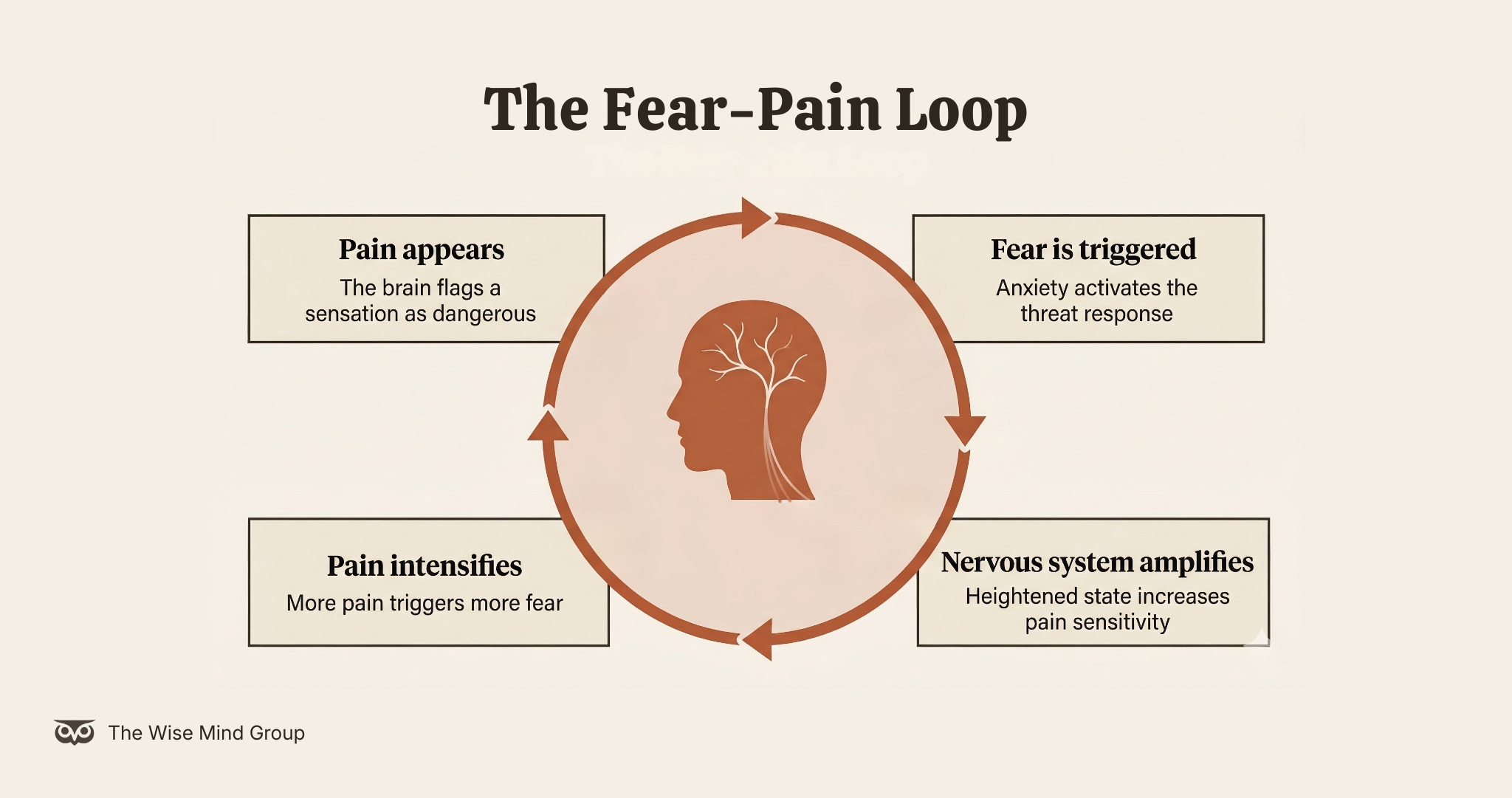
For someone with an overcontrolled temperament, this loop is especially powerful. High threat-sensitivity means the nervous system is more likely to read sensations as dangerous in the first place. The habit of suppressing emotion and pushing through means the internal distress driving the loop rarely gets addressed. And the hypervigilant scanning of bodily sensations, checking, worrying, monitoring, actually reinforces the brain's decision to keep the alarm on.
Alan's approach does not ask you to ignore pain. It teaches you to change your relationship to it. By approaching sensation with curiosity and a sense of safety rather than alarm, the brain gradually learns that the signal is not necessary, and the pain begins to quiet.
For many people, chronic pain is like the check engine light in your car that never turns off. The problem isn't your engine, it's the light.
What This Means for Recovery.
Understanding the overcontrol-pain connection is not about adding blame to an already heavy situation. Quite the opposite. It shifts chronic pain from being a mystery or a personal failing into something that makes complete sense given how your nervous system is wired and what you have learned to do to survive.
It also opens a door. If chronic pain is a learned pattern in the brain, the brain can learn something different.
In our practice we utilize Pain Reprocessing Therapy to help you approach pain with curiosity rather than fear, gradually teaching the nervous system that the sensation is not dangerous, addressing the suppressed emotional experiences that may be fueling the signal, and reducing the hypervigilance that keeps the alarm stuck in the on position. What people tend to notice however, is that once they learn to break the fear pain cycle with one symptom, other symptoms often appear.
That’s why we also work with you to address the root cause of the pain: nervous system dysregulation. We are one of the only clinical groups in the US currently utilizing Radically-Open Dialectical Behavioral Therapy (RO-DBT), which has extensive research demonstrating its efficacy in helping people with overcontrol, helping you move your nervous system out of its default threat state. Over time, you become less and less likely to have pain symptoms at all.
When we help someone express emotions more freely, reduce self-criticism, and build flexibility in how they respond to their inner experience, we are working on the same underlying nervous system patterns that Alan's research identifies as central to chronic pain. Pain Reprocessing Therapy targets the nervous system’s response to pain, while RO-DBT helps target the behaviors that keep the nervous system locked in the heightened threat state that often leads to one pain symptom after another. We help you get to the root cause.
Your pain is real. Your nervous system is not broken. It is doing exactly what it learned to do to keep you safe. And what was learned can be unlearned. The brain's capacity for change, its neuroplasticity, means that recovery is genuinely possible, often without further medical intervention.
You deserve to have your life back.
Is chronic pain ever caused by the brain rather than the body?
What does an overcontrolled temperament have to do with chronic pain?
What is the fear-pain loop and how does it work?
How is this different from being told the pain is all in my head?
What kind of professional support addresses this type of pain?
Where can I learn more about the science behind neuroplastic pain?
Beyond the insight.
Knowledge is the first step; integration is the work. If you're ready to move these concepts into your actual life, let's talk about a strategic path forward.
Book a Consultation