
The Efficiency Trap That is Making Us Sick
The Day Nobody Could Share
In 1929, Stalin had what he thought was a great idea to squeeze as much as he could out of the Soviet industrial economy. When everybody had Sunday off, all the machines in the factory sat idle. So instead, all the workers were staggered onto rotating schedules, and each group had a different day off. Within a year, a letter appeared in the national paper:
“What is there for us to do at home if our wives are in the factory, our children at school, and nobody can visit us? It is no holiday if you have to have it alone.”
People suffered states of disastrous mental health. Productivity fell. Machines broke down. The experiment was abandoned after eleven years. Stalin thought he was solving an efficiency problem. He was actually dismantling the one thing that kept the system running: the synchronized rhythm of human connection.
What our Biology Still Remembers
Humans were never the strongest or fastest animal on the planet. We thrived only because we learned to work together. For hundreds of thousands of years, belonging to a tribe was not a lifestyle preference. It was the difference between making it through the night and not.
Natural selection did not reward the lone genius. It favored the one who could hold a coalition together, read a room, repair a rupture, and show up when things got hard.
That history is in all of our DNA. It runs deeper than any belief we hold about independence or self-sufficiency. The nervous system built to keep us connected has a very specific response when that connection starts to disappear.
It calls it a threat. And it responds the way it responds to any other threat to survival; progressively lighting our nervous system up with alarm and vigilance until it simply cannot be ignored.
The Slow Boil
Today in the US, we are doing a version of Stalin’s experiment. We just cannot see it as clearly because we chose it ourselves, and because the water has been heating slowly enough that nobody is jumping out of the pot.
Smart phones and social media arrived first. Over the course of 15 years, we traded connection for “connections.” We learned to broadcast and scroll instead of gather and talk. Between 2012 and 2018, the years smartphones reached saturation, teen loneliness nearly doubled in 36 out of 37 countries studied.
Then the pandemic came and ratified remote work as the default. The commute disappeared, and so did the line between home and work. A study of more than three million employees found the average workday got nearly fifty minutes longer. Being constantly on for work in the same room as the people we used to come home to was the trade we made for the illusion of getting more time back.
Before we had a chance to rebuild any of that, AI arrived, and it arrived offering the most frictionless version of connection ever designed. A listener who is always available. Never distracted, never tired, never in a bad mood, never needing anything back. For someone who already finds human relationships inconvenient, demanding and unpredictable, this sycophantic replacement is all too seductive.
The Era of Frictionless Isolation
We did not choose to be lonely. But like Stalin’s failed experiment, efficiency is being favored over connection. And now loneliness is along for the ride.
Frictionless Isolation is the slow, incremental removal of every inconvenient, effortful, messy human touchpoint in our lives, mistaken at each step for progress.
And the people most at risk are not the ones who seem isolated. They are the ones who appear to have everything handled. The ones with the full calendars, the strong opinions about productivity, and the fully optimized morning routines. High-control, high-achieving people are remarkably good at building systems that work without requiring them to be vulnerable. They just did not notice that connection requires exactly that.
The Steep Price of Isolation
Social isolation, rejection, and exclusion activate the same neural circuits as physical pain. Functional MRI studies show that the anterior cingulate cortex and the insula, two regions associated with processing physical injury, light up identically during social disconnection.
Researchers believe this is not a coincidence. The attachment system appears to have borrowed the pain signal over evolutionary history to flag when we are cut off from the group. The brain does not process loneliness as a mood. It processes it the way it processes a wound.
And here is what that means practically. When chronic loneliness sets in, the nervous system does not simply feel sad. It shifts into threat mode. Cortisol rises. Inflammation increases. The immune system recalibrates for danger.
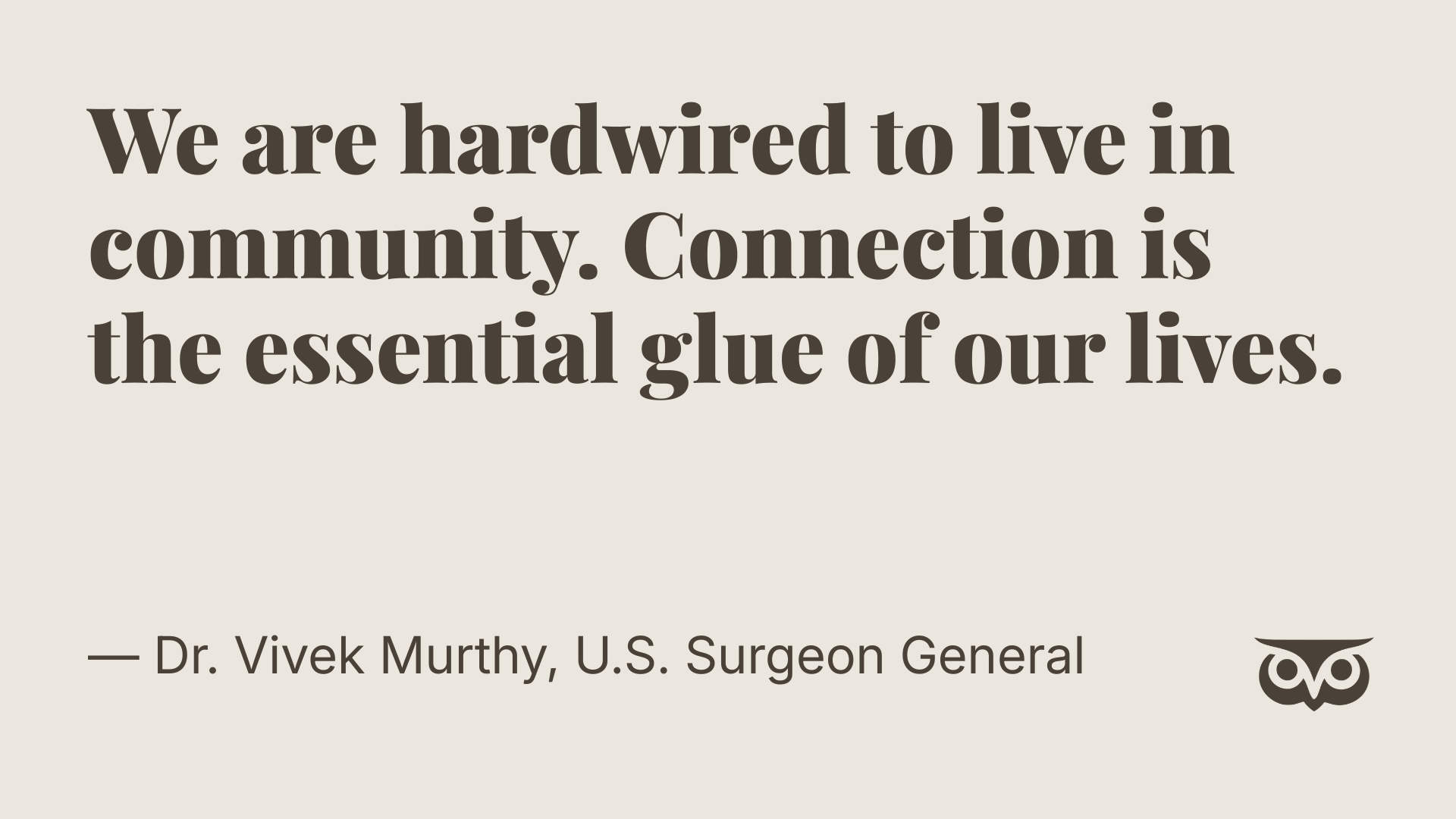
Over time, this sustained biological alarm state is associated with higher rates of cardiovascular disease, depression, anxiety, cognitive decline, and chronic pain. The U.S. Surgeon General has formally designated loneliness a public health epidemic, noting that its mortality impact is comparable to smoking fifteen cigarettes a day.
How to Reintroduce Some Friction
High-control people tend to want a system. A protocol. Something they can execute with precision and check off. That impulse, the same one that built Frictionless Isolation in the first place, will not solve it. The nervous system does not learn safety from intensity. It learns safety from the consistency of connection.
This is not a challenge. There is no finish line. Just one small act of friction per week, week after week, for as long as you are alive. Simply choose one interaction you would normally optimize away, and do not optimize it.
Call instead of text. Show up to the thing you could have watched on a recording. Stay in the conversation that meanders and goes nowhere. Put the phone down at dinner and look at the person across from you. Call a friend about the thing you were about to ask ChatGPT.
The goal is not connection as an outcome but as a practice. The nervous system does not update its threat assessment based on the number of Instagram followers you have. It calibrates on whether your body has actually experienced belonging to a tribe recently. That takes time, repetition, and yes, some friction. Even at the cost of convenience or productivity.
If you want to understand more about how the body holds the cost of chronic disconnection, including the relationship between loneliness, threat response, and physical pain, our AI Isolation page goes deeper into the clinical framework behind what you just read.
Why am I lonely even though my life looks successful?
What is Frictionless Isolation?
Why does loneliness hurt physically?
How is AI making loneliness worse?
What is the most effective way to reverse chronic loneliness?
Why are high-achievers more at risk for loneliness?
Beyond the insight.
Knowledge is the first step; integration is the work. If you're ready to move these concepts into your actual life, let's talk about a strategic path forward.
Book a Consultation