
How to Borrow the State You Need
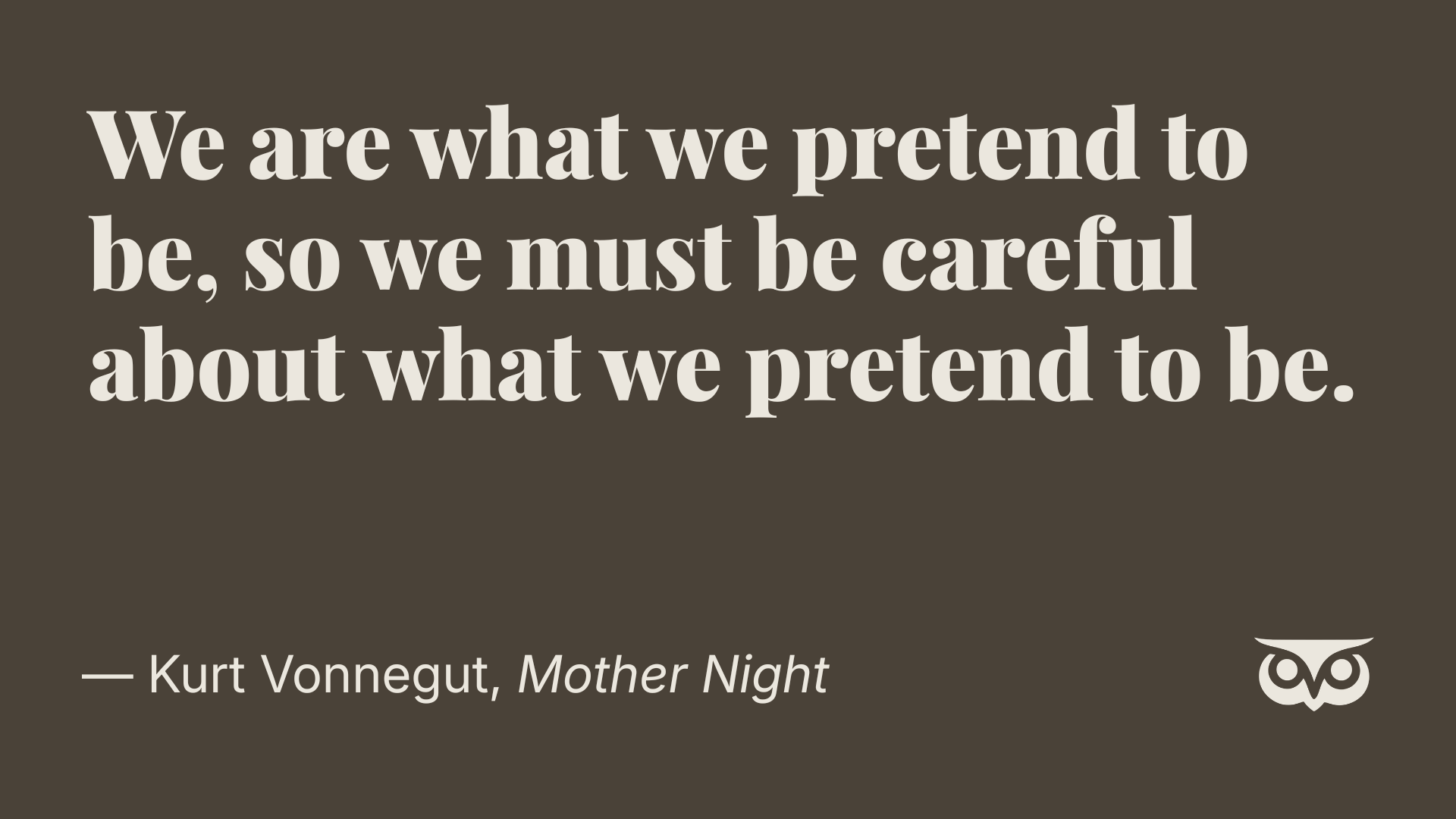
Your Brain Is Watching What You Do
When I feel anxious, I sometimes conduct a quick inventory.
How am I breathing? What is my face doing? Are my hands open, or have they quietly curled into fists? Are my eyes taking in the room, or locking onto one small point like something bad is about to happen? Am I moving at a normal pace, or rushing through everything as though the building is on fire?
Then I ask myself a strange question: If someone felt completely relaxed right now, what would they be doing differently?
I start breathing the way that person might breathe. I loosen my hands. I soften my face. I let my eyes take in more of the room. I move a little more slowly. For a minute or two, I pretend to be relaxed.
Then something interesting happens. I usually begin to feel more relaxed.
We tend to think behavior comes at the end of an emotional process. First you feel calm, then your shoulders drop. First you feel happy, then you smile. First you feel motivated, then you take action.
But science has shown that the relationship runs in both directions. Your brain uses information from your body, behavior, attention, and surroundings to understand how you are doing. Changing those signals can shift the emotional state your brain creates. With repetition, the new response can also become easier to find the next time you need it. *1
The Body Is Part Of The Story
Your brain is constantly reading signals from your breathing, muscles, facial expression, attention, and surroundings to make sense of how you are doing.
Anxiety can turn those signals into a loop. Your brain notices a possible problem. Your breath shortens. Your body braces. Your face tightens. Your attention narrows. Your brain then reads those changes as more evidence that something serious is happening.
Changing your physiology gives it different information.
A 2022 analysis of 223 studies found that voluntary slow breathing produced measurable changes associated with parasympathetic regulation, both during the breathing and afterward. *2
When you breathe like a calmer person, loosen your hands, and soften your gaze, you are doing more than playing pretend. You are changing some of the signals your brain is using to create the state.
The Feeling Can Follow The Action
There is an entire approach to treating depression built around this idea. It is called behavioral activation, and the basic premise is simple: you do not always have to wait until motivation shows up before you take meaningful action.
In a 2023 review of 22 randomized trials involving 819 people, researchers found strong support for behavioral activation as a treatment for depression. *3
The treatment itself is structured and goes well beyond telling someone to take a walk. Still, the core idea applies more broadly: sometimes action has to go first. The energy, motivation, or sense of connection may come later.
Most of our default setting is waiting for a feeling that action could help create. We wait to feel energized before going outside. We wait to feel confident before beginning. Or we wait to feel grateful before looking for something worth appreciating. Taking action can create a small opening for pleasure, purpose, confidence, connection, or relief. Your brain now has a different experience to build on.
The Story Is Fictional. The Feeling Isn't.
Have you ever become completely absorbed in a movie or television show? A character is humiliated, and you feel embarrassed for them. Someone walks into danger, and your body tightens. A beloved character dies, and you feel genuine grief. You may feel angry, relieved, shocked, or afraid. Your heart speeds up. Your eyes fill with tears. You find yourself holding your breath.
All of this happens while you are sitting safely on a couch, watching actors follow a script. You know the story is fictional but your emotional response is still real. For a few minutes, you have entered the character's world. You have seen the situation through their eyes, anticipated what might happen next, and felt some version of what they appear to be feeling.
That tells us something important. We do not always need a real event to produce a real emotion. Imagination, attention, and perspective can give the brain enough information to begin creating the state. We can use that same ability more deliberately. *4
Acting the Part
Research on gratitude practices suggests that deliberately directing attention toward what we appreciate can modestly improve well-being and reduce symptoms of anxiety and depression over time. *5 But what if I'm not feeling particularly grateful? A question I might ask then would be, "If I had to pretend to feel grateful right now, what would I be grateful for?" or "If somebody much less fortunate than I am were to teleport into my life right now, what would they be grateful for?"
The question lowers the bar. I do not have to summon a deep sense of wonder or convince myself that everything is beautiful. I only have to play the part for a moment. I look through the eyes of someone who might notice one good thing, and I can expand from there.
Sometimes I borrow another person entirely. And there's no limit as to how ridiculous that might be. When I am tired, annoyed with my kids, and running out of patience, I ask myself: What would Bandit do right now?
Bandit is the dad from kids' cartoon Bluey. He commits to the game. He gets into character. He brings play into moments when many exhausted parents would try to shut everything down. I am fully aware that he is an animated dog...yet the question still helps.
Giving Yourself a Gap
Psychologists call this self-distancing. You create just enough space between yourself and the emotion to see the situation more clearly.
You might picture yourself from across the room, ask what someone you respect would do, or even refer to yourself by name.
Instead of asking, "What am I going to do?" I might ask, "What does Eli need to do next?" *6
It sounds almost comically simple, but research suggests it can reduce emotional reactivity. A 2022 analysis of 48 studies found that self-distancing produced a small but reliable shift, especially when people put their experience into words. *7
That tiny change in perspective moves me a few inches away from the center of the emotion.
Sometimes a few inches is all I need to see another option.
It's What You Do That Defines You (Batman Begins, 2005)
What I've been presenting here isn't much different than what one study calls the Batman Effect. In a series of experiments, young children were given boring tasks that required focus and self-control. Some children approached the task as themselves. Others pretended to be a capable character such as Batman, Rapunzel, Bob the Builder, or Dora the Explorer. The children who stepped into a character showed greater perseverance and executive control. *8
No study has tested whether pretending to be Bandit makes exhausted fathers more patient. But my use of Bandit is an adult application of the same general idea.
For a moment, I stop asking what the irritated version of me feels like doing. I step into the role of the father I want to be. That reminds me that my current state does not contain every response available to me.
I sometimes do the same thing when life feels overwhelming. I imagine I am the star of an action movie. The chips are down. Everything looks bleak. This is the scene where the audience assumes the hero is finished. What does he do next? How does he carry himself? What move would surprise everyone?
It doesn't change how difficult the situation might be, but the exercise gives me access to a different script. For a moment, I rehearse courage.
Teaching Your Brain A New Sequence
There is another reason to practice this, even when the immediate shift feels small. You are teaching your brain a sequence. Anxiety arrives. You notice the breath. You open your hands. You soften your gaze. You slow the next movement. You ask a different question.
The phrase "neurons that fire together, wire together" simply means that patterns of neural activity that occur together repeatedly can strengthen their connections. *9 Repeated behaviors can also create associations between a cue and a response.
Your clenched hands can become a cue to open them. A shortened breath can become a cue to lengthen the exhale. Irritation with your kids can become a cue to ask what Bandit would do. An anxious thought can become a cue to widen your attention.
At first, every step may require conscious effort. You have to notice the state, remember the practice, and choose the response. With repetition, that sequence can become faster and easier to access. One small study gave participants 150 opportunities to practice cognitive reappraisal, the process of changing how they interpreted an emotional situation.
As they practiced, they became faster at regulating their emotions. Two weeks later, they were more likely to regulate spontaneously and described the response as more habitual. *10
Research on implementation intentions points in the same direction.
An implementation intention connects a specific cue to a prepared response:
If I notice my hands clenching, then I will open them and slow my exhale. Over time, the cue begins to retrieve the response. *11 This matters because stress narrows our options. Under pressure, the brain often reaches for the sequence it knows best. *12
When the familiar sequence is brace, rush, catastrophize, and snap, that is where the nervous system tends to go. Each deliberate repetition teaches it another route.
Borrow One State For Sixty Seconds
The next time you feel anxious, irritated, defeated, or emotionally cooked, ask one question:
How would someone in the state I need handle the next sixty seconds? Keep the time frame small. You are borrowing a state long enough to make one different move.
Start with the body: How would this person breathe? What would their jaw be doing? Would their shoulders be pulled toward their ears? Would their eyes be hard and narrow, or soft enough to take in the whole room?
Then look at their pace. Would they rush through the next task? Would they speak quickly or loudly? Would they move as though every second had already been spent?
Borrow one physical signal.
When relationships or parenting feels heavy, ask what a patient and playful person (or animated canine) would do with the next minute. When the chips are down, ask what the hero does in this scene. When gratitude feels unavailable, ask what someone less fortunate than you might notice that is worth appreciating. When a problem has consumed your attention, ask how you would carry yourself if your nervous system already understood that the problem was difficult and survivable.
Self-compassion always belongs at the center of this practice. You may be exhausted because you need rest. You may be angry because a boundary has been crossed. You may be anxious because something genuinely matters. This practice gives you more than one way to meet the moment. Sometimes the borrowed state will shift how you feel, and other times it will simply help you choose a better next move. Each repetition becomes a small rehearsal for the next difficult moment.
Can you actually change how you feel by changing what you do?
What is a borrowed state, and how do you use one?
What is the Batman Effect, and does it work for adults?
What is self-distancing, and why does it help?
Does behavioral activation actually work for depression?
How does practicing this over time change the brain's response to stress?
References
*1 Seth, A. K. "Interoceptive Inference, Emotion, and the Embodied Self." Trends in Cognitive Sciences, 2013. https://pubmed.ncbi.nlm.nih.gov/24126130/*2 Laborde, S., et al. "Effects of Voluntary Slow Breathing on Heart Rate and Heart Rate Variability: A Systematic Review and a Meta-Analysis." Neuroscience & Biobehavioral Reviews, 2022. https://pubmed.ncbi.nlm.nih.gov/35623448/*3 "Individual Behavioral Activation in the Treatment of Depression: A Meta Analysis." Psychotherapy Research, 2023. https://pubmed.ncbi.nlm.nih.gov/37068380/*4 "The Paradox of Fiction: Emotional Response Toward Fiction and the Modulatory Role of Self-Relevance." Emotion, 2016. https://pubmed.ncbi.nlm.nih.gov/26922617/"Perspective-Taking as Part of Narrative Comprehension: A Functional MRI Study." https://pubmed.ncbi.nlm.nih.gov/19135072/*5 Diniz, G., et al. "The Effects of Gratitude Interventions: A Systematic Review and Meta-Analysis." Einstein, 2023. The analysis included 64 randomized clinical trials. https://pubmed.ncbi.nlm.nih.gov/37585888/*6 Moser, J. S., et al. "Third-Person Self-Talk Facilitates Emotion Regulation Without Engaging Cognitive Control: Converging Evidence From ERP and fMRI." Scientific Reports, 2017. https://pubmed.ncbi.nlm.nih.gov/28674404/*7 "Reflect on Emotional Events From an Observer's Perspective: A Meta-Analysis of Experimental Studies." 2022. The analysis included 48 studies and 102 effect sizes. https://pubmed.ncbi.nlm.nih.gov/36256910/*8 White, R. E., et al. "The 'Batman Effect': Improving Perseverance in Young Children." Child Development, 2017. https://pubmed.ncbi.nlm.nih.gov/27982409/White, R. E., and Carlson, S. M. "What Would Batman Do? Self-Distancing Improves Executive Function in Young Children." Developmental Science, 2016. https://pubmed.ncbi.nlm.nih.gov/25997842/*9 The phrase is shorthand for Hebbian plasticity rather than a verbatim quotation from Donald Hebb. See: "Hebbian Plasticity Requires Compensatory Processes on Multiple Timescales." Philosophical Transactions of the Royal Society B, 2017. https://pubmed.ncbi.nlm.nih.gov/28093557/*10 Christou-Champi, S., Farrow, T. F. D., and Webb, T. L. "Automatic Control of Negative Emotions: Evidence That Structured Practice Increases the Efficiency of Emotion Regulation." Cognition and Emotion, 2015. https://pmc.ncbi.nlm.nih.gov/articles/PMC4241596/*11 Hallam, G. P., et al. "The Neural Correlates of Emotion Regulation by Implementation Intentions." Human Brain Mapping, 2015. https://pubmed.ncbi.nlm.nih.gov/25798822/*12 Schwabe, L., and Wolf, O. T. "Stress Prompts Habit Behavior in Humans." Journal of Neuroscience, 2009. https://pubmed.ncbi.nlm.nih.gov/19494141/Note: Later preregistered replication studies produced mixed findings, so this claim should be presented as a tendency rather than a universal rule. https://pmc.ncbi.nlm.nih.gov/articles/PMC9969070/Beyond the insight.
Knowledge is the first step; integration is the work. If you're ready to move these concepts into your actual life, let's talk about a strategic path forward.
Book a Consultation